Blessings from a shaman

It starts as a drizzle after dinner … a soft pitter patter on the roof of the main area at the Park. It’s dark, so we can’t really see the full effect. But, we can hear it.

Within minutes, that light little drizzle gives way to sheets of rain, dumping from the sky. As we make our way up to a deck on the compound, the rain pounds the roof, dripping in from the open sides of the room and onto us.

This is Thailand’s rainy season, and it is pelting us with all it’s got on our first night at the Elephant Nature Park.

We enter the room to young adults from the nearby village playing traditional Thai music, and a few elders, sitting cross-legged. We leave our shoes at the door and walk across the floor to take a mat and be a part of the Baci welcome ceremony.
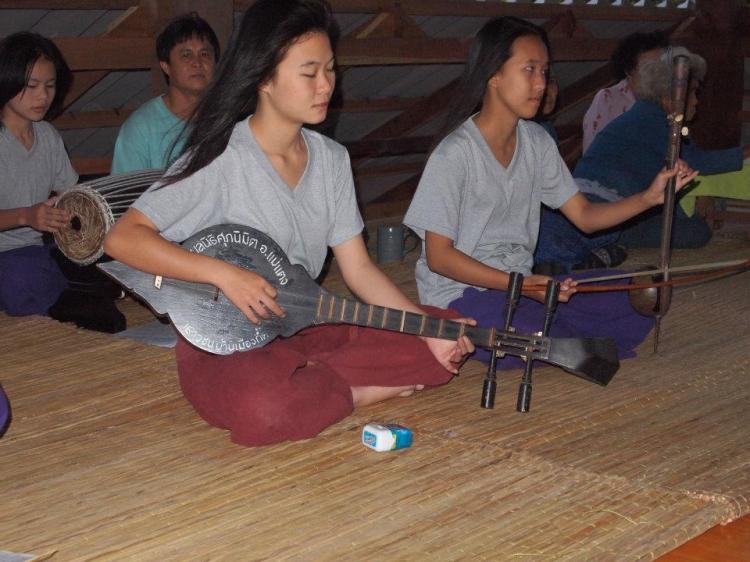
Youth from the village play music. Photo: Gabrielle Aw

“We need a few volunteers,” Jack announces.

My hand shoots up, along with three other girls — Marie and Adele (sisters who are in their second week at the park), and Jasmin.

Marie and Adele give me a quick rundown since they did the ceremony the week before.

“Don’t point your feet at anyone,” says Adele. “You have to sit mermaid style. And, be sure to clasp your hands and bow when appropriate.”

I tuck my legs to the side, away from the elders, and, following everyone else’s cues, put my hands together (called “wai”) in front of my face.

Then, the ceremony starts.

My eyes grow wide as the shaman begins to chant.

I have no idea what he is saying, but I know this: we are being blessed.

The ritural celebrates important events and occasions, such as a welcoming of volunteers. We begin with the shaman evoking the kwan, which watches over our 32 organs. According to ancient beliefs, it is important to have as many kwan as possible together in the body. The ceremony calls the kwans from wherever they are to return to our bodies.

To enable this, the paw kwan is prepared. Placed on a silver tray, the cone is made of banana leaves and, at the center, are a bundle of flowers to symbolize love, longevity and more.

The paw kwan.

It is intricate. It is beautiful. I immediately begin to feel ridiculously blessed, not just because of the ceremony, but because it hits me just how fortunate I am to be sitting here.

We sit for a long time, as the shaman has us place our hands on the paw kwan and douses us with water. He takes a bundle of string and loops it around each of our hands, ending with Adele, across from me.

Photo: Gabrielle Aw

Then it hits me. My legs are in such pain. After having them tucked to the side and our hands in prayer, it is really hard to sit up straight. And to be comfortable. I try to adjust, but can’t kick my feet around.

Hang in there, D. Keep it together.

I look to the other girls. How are they doing it? Aren’t they in pain? If they are, their faces give nothing away.

Then, it’s time for the white cotton string to be tied around our wrists for good luck. First, he snips the string at my wrist, then wraps it around, tying it in a knot. He proceeds to each girl, snipping and tying, until we all have these blessings on our bodies.

Receiving the white cotton string for good luck.

While he ties them around our wrists, the women step out into the crowd and tie it around the wrists of the rest of the volunteers who wish to be blessed.

When it is over, I stretch my legs out. Ahhh.

The rain is still beating on the roof, but I’ve been so entranced by the ceremony, I haven’t noticed.

I retreat to my room, using a torch to guide my way, before 8:30 p.m. I fall asleep to the chirping of crickets, cicadas and occasional elephant conversation.

It’s the most peaceful sleep I’ve had in a long time.
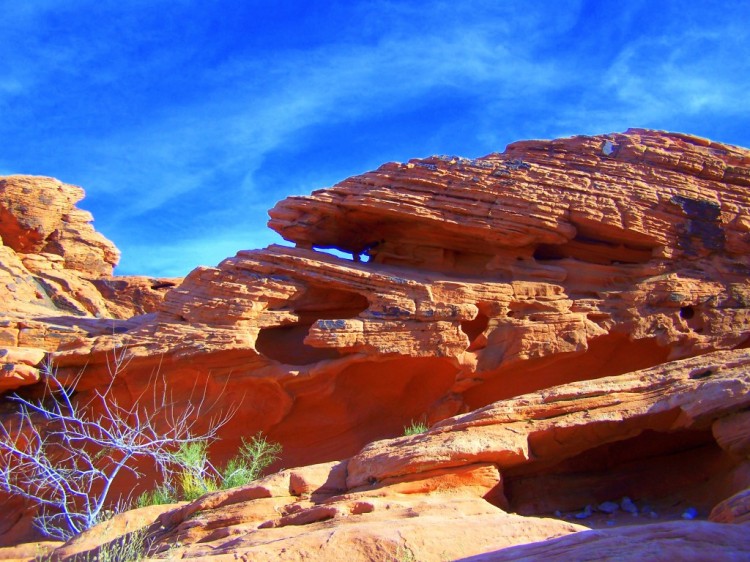
Escape of the Week: Nevada’s Valley of Fire

Las Vegas, a look at the Valley Of Fire

About an hour outside of Las Vegas is the Valley of Fire. Dedicated in 1935, it is Nevada’s oldest and largest state park.

And, it is one of the most beautiful places I have ever seen.

With a background of bright blue sky, the red sandstone formations are striking. They’ve been around since the days of the dinosaurs, a not-so-shabby 150 million years.

A perfect day trip, there is plenty do to in the park. For nature-lovers and hikers, there are trails that weave around some of the stunning formations, including the beehive rocks smoothed over time. Plus, there’s places to picnic and camp, too.

Want to go?

From Las Vegas, take I-15 North to Exit 75.

Don’t forget to bring your camera!

A room at the (primitive) Palace

I don’t expect much when Jack hands me the key to my room, a hut in the Palace complex.

On the Elephant Nature Park’s Web site, it states the toilets are squat and the showers are Thai (meaning buckets to rinse, no shower heads), so when I walk the few feet to my lodging for the week, I am not getting my hopes up.

The walk from the main area to my room isn’t far. In fact, aside from the staff quarters, my hut is probably the closest. I stroll down the dirt road, paying careful attention to my surroundings. To my right is the gate to the elephant’s habitat. Then, there’s one of the shelters that houses two of the elephant families with babies. Then, some jungle foliage and … the Palace complex.

Yes, it’s called The Palace.

It’s a fairly basic structure, two wooden huts on a platform. I walk up the creaky stairs to my hut. And that’s when I hear it: elephant chirping. I peer around the massive tree on the side of my front porch, and there they are — the elephants.

Amazing.

Key in hand, I unlock the padlock on my door and step inside.

It takes a moment for my eyes to adjust to the darkness.

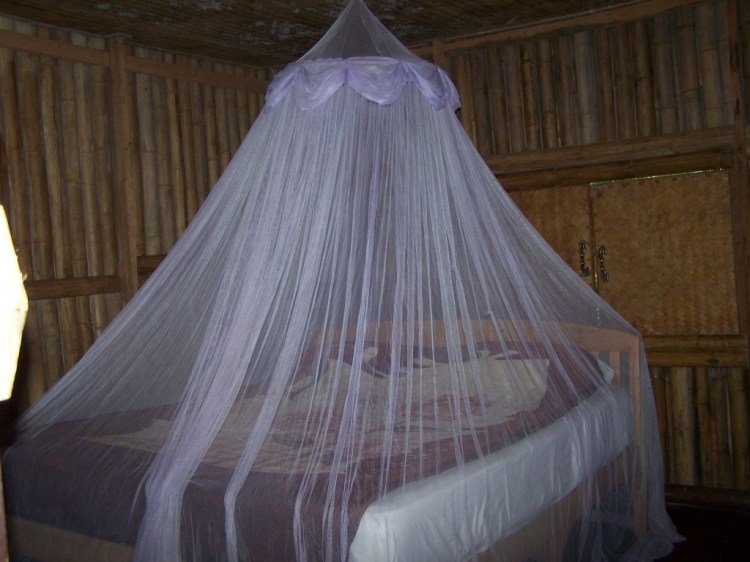
The room is bare, save for a queen-sized bed flanked in mosquito netting. It’s all very primitive.

There are three sets of windows, a fan and one little light.

My palace for the week at Elephant Nature Park

I’m not staying here for the accomodation. I’m staying here for the elephants.

I drop my bag down next to my bed and take a pre-cursory sit on it. It’s pretty comfortable. I run my hands over the warm blanket. Soft. I grab a pillow and squeeze it to me. Perfect.

Then, I stand up and go to each of my windows, throwing open the wooden shutters.

Even though rain threatens us, light floods the room. I walk to the set of windows that opens to the elephants.

They are right outside of my window.

Elephants. I am sleeping nearly next to elephants.

A tinge of “holy shit” runs through my veins.

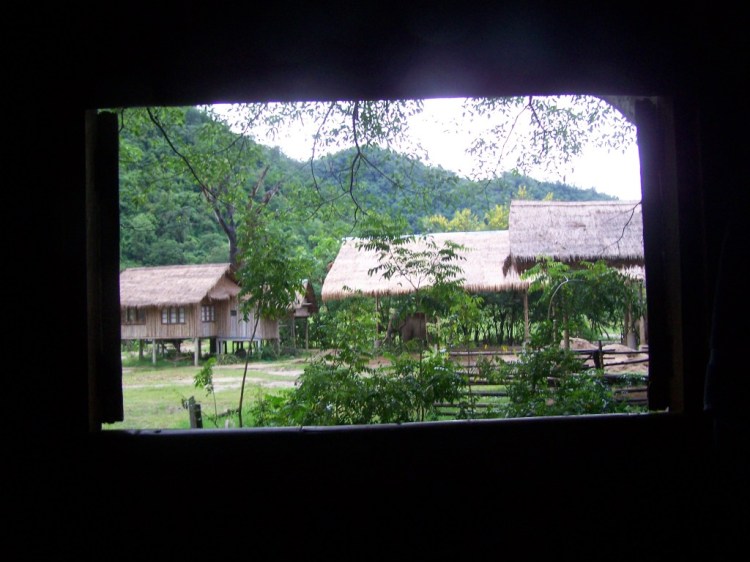
The view from the porch of my palace

I have a few minutes to unwind before I have to go back to the group to watch a documentary on Asian elephants.

I do a quick investigation, walking down a wooden walkway between my room and the other, to the bathrooms and showers.

I am greeted with a western toilet and a western shower. With hot water. (Apparently, the Palace is the only complex with hot water, so I lucked out, even if it was too hot outside to enjoy hot showers.)

I head back to my room for a few and crawl onto my bed and lay on my side, just staring out at the spectacular scene in front of me.

A view from my room

Outside of my window, there are beautiful trees with glistening leaves. In the distance, emerald green mountains loom, with a fine layer of mist cutting across.

And there, right there, out my window, are elephants.


Floating elephant poo and other awesomeness

“Ele poo! Look out, ele poo!” Jack screams as we wade into the rushing water, elephants at our side.

Sure enough, there are huge balls of elephant poo floating by our legs.

It’s like the elephants just hold it until they hit their own, big rushing river toilet.

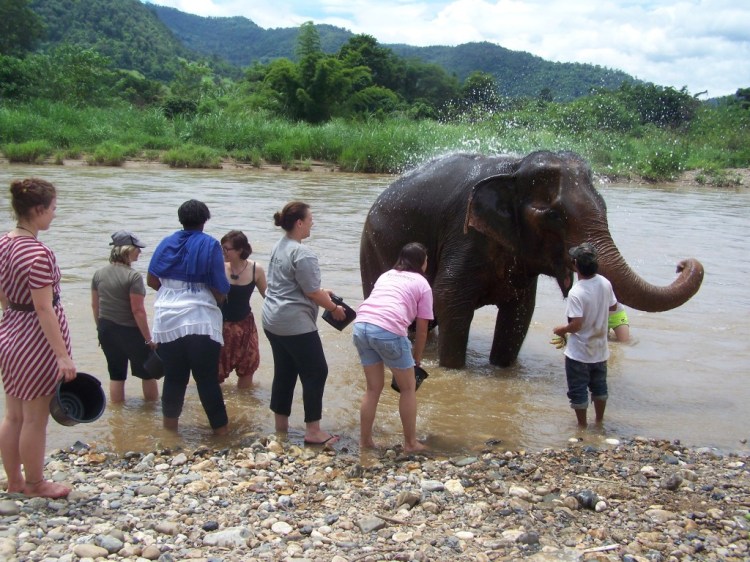
Before we get into the water, we are given little black buckets and told how to wash the elephants. Basically, stick the bucket into the river water, fill it up, then throw the water on them.

And, that is exactly what we do.

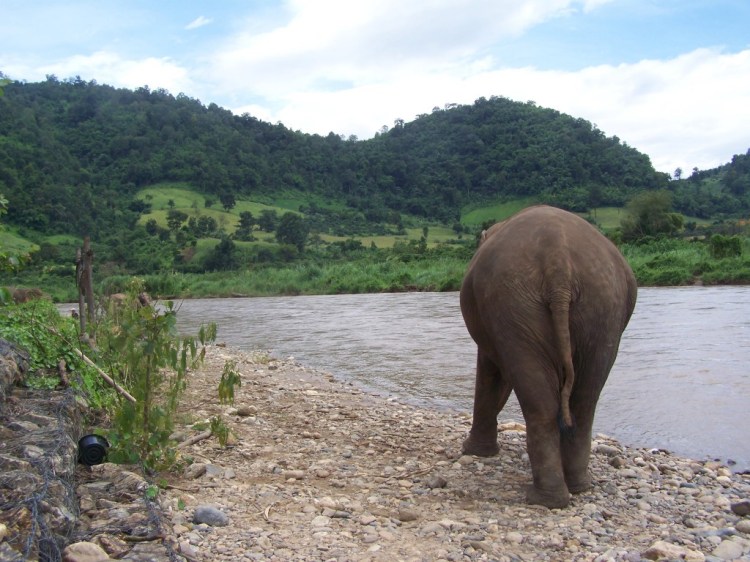
An elephant heads down to take a bath

I’m standing next to one of the elephants … really close, and filling up the bucket of water and tossing it over her head. Onto her back.

There’s water coming at me from all sides. Not only is our volunteer group bathing these girls, but the visitors to the park are in the water, too. Groups of about five or 10 concentrate on an elephant. Within a minute of getting into the water, I am properly drenched.

I watch as the elephant I’m helping bathe blinks each time the water splashes into her face. Then, she sticks her trunk into the river and sucks up water, flings her trunk over her head, and shoots it onto her back.

Bath time!

Clearly, these elephants are able to clean themselves, but they stand there and patiently let us get our time with them. What makes me even happier? I swear, the elephants look like they are smiling huge smiles that rival ours.

For 10 minutes, I dunk, toss and repeat. It never gets old. Each time, I give myself a reality check between dodging the floating poo.

Standing in a river. In Thailand. With elephants.

“OK, you need to get out of the water now, Hope is coming with his girlfriend,” Jack warns us, ushering us out of the murky brown, poo-filled water and onto the bank of the river. “Go upstairs and watch from the sky deck.”

The volunteers have heard about Hope. He’s been with Lek and the park since he was a baby and his mother died. Lek has spent a lot of time with the boy, who the staff refers to as “naughty” since he is going through musth and all about the lady elephants these days.

He’s also a part of the future of the park. Hope, who used to have a bell around his neck so people would know when the mishcevious little boy was around, is being trained using positive reinforcement. He is fortunate enough to never have been put through the crush. Instead, he learns tricks by being rewarded with heaps of fruit.

We all stand at the deck as Hope and his girlfriend make their way into the water.

The two walk together into the middle of the river, their huge bodies barely noticing the rushing water. Then, Hope dunks himself, rolling onto his side.

The group of volunteers, the day-trippers, we all let out giggles and “ooohs” and “aaahhhhs” as the two elephants spend five minutes dunking and rolling around in the water.

On cue, the two emerge from the water and its time for Hope to show off his tricks. With mahout at his side, he walks up to little buckets placed strategically below the sky deck. He sticks his trunk into the water, sucks it up, and then shoots it up at us.

Squeals of delight.

He eagerly takes the bananas from his mahout’s hand and shoves them into his mouth.

Then, he kicks his legs to the side and is rewarded with more bananas.

It’s heart-warming. And inspiring.

Once Hope heads back to graze, the large elephant family comes down to meet visitors. They stand in the grass, munching on bananas and other fruits, and one-by-one, people get their photo taken with one of the baby elephants who has learned to give trunk kisses in exchange for food.

A person stands next to her, then the long trunk snakes its way to the face, landing somewhere — anywhere on the face — and leaving little dirt marks. Then, the trunk finds its way into the caregiver’s hands and bounty of fruits.

We stand watching for a few minutes, until Jack once again, herds us inside.

“It’s time to get your rooms!” He announces.

At first, I don’t want to leave them. I could watch them eat, fling dirt on their backs to cool off, rub against the wooden posts scratching themselves, dip into the water, stand around doing nothing, all day. Then, I remember I am here a week. And, this is just my first few moments with them.

Baths, feeding, caring for them … it all awaits and will unfold in the next six days.

Escape of the Week: Birds on a Wire

I celebrated my one-year anniversary of returning to Las Vegas on October 30.

Actually, the day came and went, and I didn’t even remember it’s been one year until today, but I digress.

The day I caught the flight to Las Vegas from Maryland, I went through a photographing frenzy. As I drove to drop off my car (it was being shipped across the country via truck), I snapped photos like it was my job. The way the rising sun hit the golds and reds of the trees. The wispy white clouds against the bright blue.

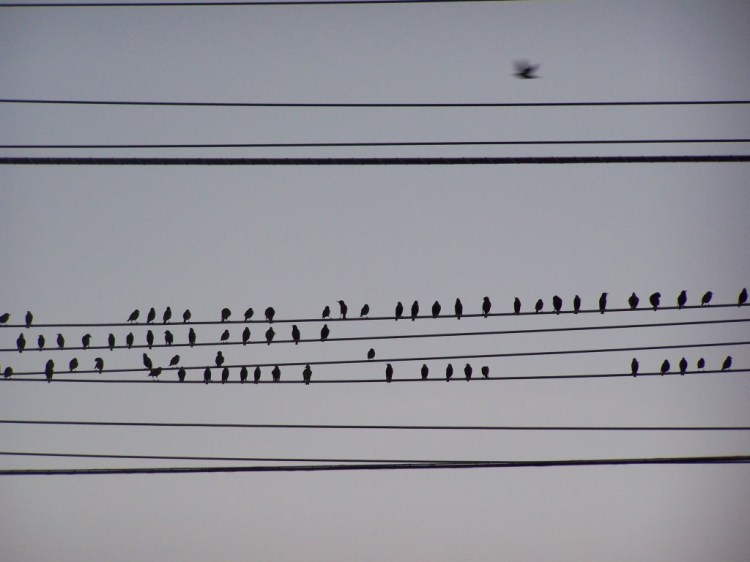
The birds on the wire, staying warm on the chilly late autumn morning.

Sure, it’s not one of the photos that will ever win an award for composition, but on this year-plus of being in Vegas, seeing this photo makes my heart warm. While I live here, this is not my home. Actually, I don’t know where home is. But, I do know where my family is. And this photo reminds me of Maryland, and my family. Right now, that’s all I need.

The Thailand Foodgasm: The ultimate Thai buffet

The lunch bell rings at Elephant Nature Park at noon.

Had we really already been there a few hours?

The time so far has flown by.

And, while I love that the experiences were that supremely amazing thus far, I don’t want the week to fly by. I want to savor every single moment and feel every single second. Especially those times I was with the elephants.

I’ve been there a short time and I already never want to leave.

We approached the main area and that’s when I see the food.

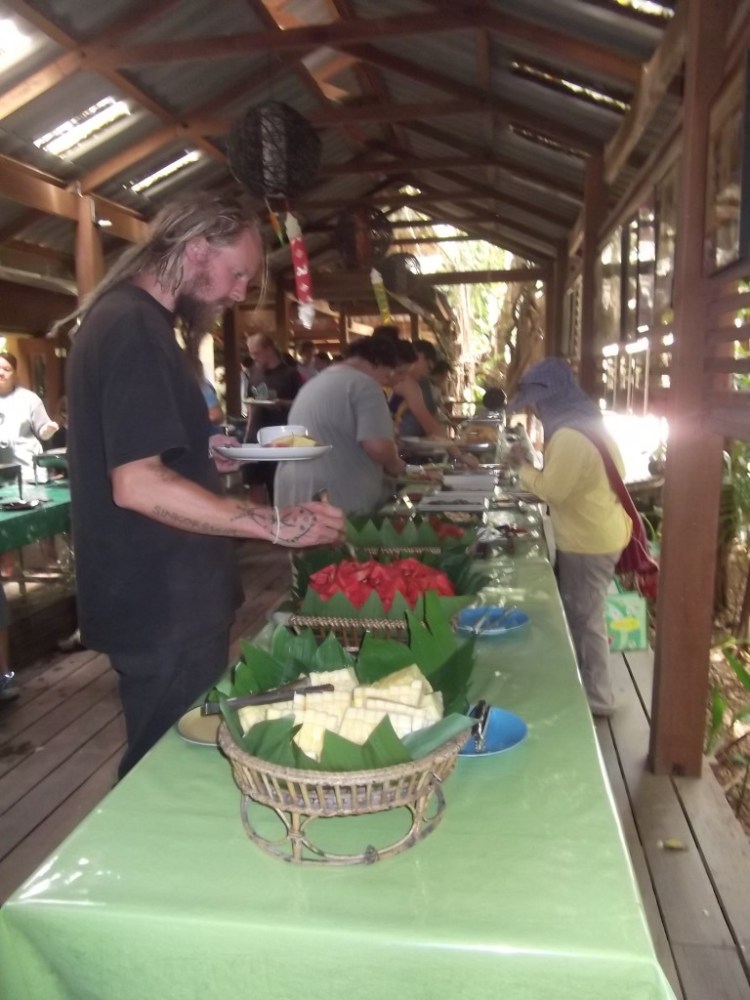
Just outside of the massive kitchen are two long tables. And, on top of those tables are pan after pan after pan of home-cooked Thai food.

Before coming to the park, I had read about the food from other people. It had received nothing but rave reviews, and now, displayed on two tables are more Thai dishes than I can ever imagine.

Massive, epic buffet. Photo: Sarah Bird
Massive, epic buffet. The other table. Photo: Sarah Bird

There’s Pad Thai. Three types of curry. Tofu prepared 10 different ways. Taro chips. Salads. Lychee. Rice. Soup. And more.

My eyes bulge and I realize I’m really hungry.

I load up my plate with a little bit of everything and head to one of the long wooden tables that looks out onto the park. In the distance, I see two elephants in a green shelter. The medical shelter. Further out, there are more. And water buffalo. About 100 of them, grazing in the long grass and sloshing in the puddles.

Everyone in the volunteer group are instantly friends. Lucy, Katy and I talk about re-entry. By the end of our first lunch, I feel like this group of people, this experience with this group of people, will be one of the most memorable experiences in my life.

We finish eating, then Jack tells us its time for our next activity: bathing the elephants.

He reminds us to respect Thai culture and not walk around in our swimsuits, but instead put them on underneath of our clothes.

I run to my backpack (we would get our room assignments later), grab a pair of shorts, a T-shirt, my bathing suit and my water shoes, and quickly change.

Bathing elephants! Being able to stand next to these creatures in a river and dump water on them! Excitement pounds through my veins as we make our way down to the river bank and the elephants, wading in the rushing water.

Escape of the Week: The Dead Sea

I love Israel. I have loved Israel since the moment I visited, on a Birthright program in spring 2001.

I remember my time there very clearly. Clashes had just started breaking out between Israelis and Palestinians, and I was really scared to go visit the country.

But, I did.

For 10 days, my group of about 25 people visited many places in the country, including the Dead Sea. In a bullet-proof bus (due the recent violence), and with two body guards at our sides, we drove from Jerusalem to the Sea.

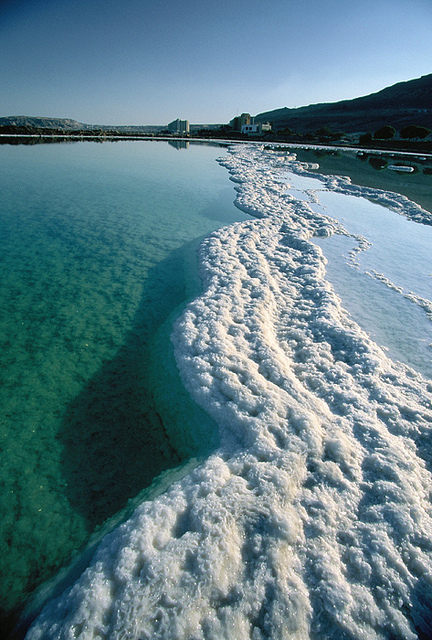
I remember taking it in — the magnificent swirls of the water in bright blues and greens. I remember dipping my toes in. And, I remember floating in mere inches of the warm water.

Now, the Dead Sea is up for one of the New Seven Wonders of the World.

I didn’t take this photo, but I wanted to share the beauty of the Dead Sea with you. If you’ve ever been there, please share you experiences below!

AND, please take a moment and vote for The Dead Sea to be included as one of the new seven wonders of the world.

Don’t forget to head over to the Facebook page to show your support, too!

Photo Courtesy Israel Ministry of Tourism

Feeding elephants

Within an hour of arriving to the park, I have met my first elephants.

Our van is the first to arrive at Elephant Nature Park, so we drop our bags, and sit down. But, it is hard for any of us to sit still.

There are elephants. Everywhere.

Not just the actual animals, either. There are elephant carvings. Walls covered with stories of elephants. Photos of elephants and their mahouts.

Jack sits us down and goes over the rules: don’t approach an elephant without its mahout; don’t tease the elephant with food; never stand directly in front of the elephant; don’t stand over the line on the feeding platform; don’t place the food directly in the elephants mouths.

They’re basic rules, but ones that could save our lives. We are told to remember, while these elephants are all living here safely, it doesn’t mean that we are necessarily safe around them. They may have grown up in captivity and have been victims of unspeakable abuse at the hands of humans, but, at the end of the day, they are still wild animals. Wild animals with silent footsteps, who weigh upwards of six tons.

“OK, then, we will go feed elephants,” Jack announces.

I can’t believe where I am, what I am doing, as we walk through the mud and fields to meet our first elephant.

Elephants. Real elephants. Standing in front of me.

Our group approaches Mae Tee under a shelter, her mahout standing by her. In front of her are two buckets, filled with halves of watermelon and small bananas still on the stem.

Mae Tee and her best friend, Mae Kham Geao. You can clearly see the scars from being beaten with the hook on her head.

Mae Tee is a former logging elephant. She first worked in the industry when it was legal, and then when Thailand banned it, since it was all she had known, she worked in the illegal industry. Already in poor condition, her owners fed methamphetamine to keep her going. However, after working tirelessly (thanks to the pills), her body began to lose fat and muscle and the cartilage in her front wrist joints deteriorated. Her ankle joints were entirely worn. Because of the exhaustion, she stopped listening to commands, resulting in beatings with the hook, causing deep trenches in her head, to keep her moving.

While not much is known about her past, her owners realized she didn’t have much left in her, so they took her off the job. However, she ended up once again working at a rubber tree plantation, once again logging. Lek Chailert, the founder of the park, found her after she was sold to a nearby trekking camp. When she collapsed from exhaustion and malnutrition, the owners decided to sell her to Lek. Within days of arriving to the park, Mae Tee made friends with another elephant, Mae Kham Geao, who had a similar upbringing.

Jack quickly explains to us about elephant relationships. It turns out, they are similar to humans. They make friends. They have boyfriends/girlfriends. They chat with each other, an adorable clucking sound.

“Go ahead,” Jack coaxes. “Walk up to her.”

We stand there, a few feet away, staring at her. Mae Kham Gaeo is next to her, being fed at the same time.

I’m in pure awe.

A lifetime of seeing elephants in photos, on television, and now … I am so close to one.

We tentatively walk up to her.

“Give her food,” Jack instructs. “Give her a cluster of bananas.”

I watch as one by one, the group begins to grow more confident near her.

Mae Tee’s long, pink speckled trunk curiously reaches towards Sarah’s hand holding the fruit. We can hear her breathe in the scent, and then quickly wrap her trunk around the food and put her trunk into her mouth, depositing the bananas onto her big, pink tongue.

Slosh. Slosh.

Ready to eat the entire cluster
Slosh, courtesy of Mae Kham Geao.

Then, it’s my turn. I give Steven my camera and instruct him to take photos. I feel such an urgency, an importance, in having my first moment with Mae Tee documented.

I stick my hands into the bucket and pull up bananas.

Mae Tee’s trunk is swinging out towards me. For a moment, I hesitate as she begins to touch her trunk on my hand, around the fruit.

I’m feeding an elephant. 

My hand touches her trunk. It feels like leather, with coarse hairs sprouting up from her skin. I am instantly in love.

I keep thinking to myself, over and over, how blessed I am to be standing next to this rescued creature. My heart aches for her story, the life she had lead up until 2009 when she arrived to the park. And then, my heart bursts with warmth and joy at the life she is living now.

I touch her and I want to hug her. I want to wrap my arms around her big neck and just feel her skin against my face. I want to cry because the moment for me is just sheer amazing. It is a moment I never want to lose.

She takes the fruit, curls her trunk into her mouth, and chomps on the entire cluster.

The smile on my face can’t be contained as I watch her chew.

We continue to feed her and Mae Kham Geao for about 30 minutes, laughing at how smart Mae Tee is. She likes her bananas, not the watermelon. So,whenever she is handed a watermelon, she accepts it, and then tosses it behind her with her trunk. It isn’t until all of the bananas are gone that she is willing to eat the juicy fruit. In its entirety.

The group of us laughs at her adorable picky eating.

She’s a lucky girl.


Friendship

I look back at the two elephants as we head to the main area for lunch — something I have heard nothing but raves about from other visitors to the park.

She’s standing there, talking to her best friend. Their trunks tangle together as they softly chatter.

My heart nearly explodes with joy.


For more information on Elephant Nature Foundation and Elephant Nature Park, please visit www.saveelephant.org

For more information about the elephant tourism industry and why you shouldn’t ride elephants, support circuses and more in Thailand, click here.


Escape of the Week: Fall on Fire

If there is one thing I miss when living in the desert — even if October is simply divine weather-wise — it is fall.

Growing up on the east coast in Maryland, a favorite pastime was raking all of the leaves that fell from the trees each autumn. My dad would rake them up into piles, and then my brother and I would jump into them with reckless abandon.

I loved the smell of the leaves … fresh and earthy.

But, more than that, I loved the colors. Against the gray October skies, the leaves would burst with color. Bright and fiery oranges and reds. They glowed.

After moving from Las Vegas to Georgia in 2010, I was once again greeted with the beauty of this season. My friend and I decided, on a crisp and cloudy fall morning, to get in the car and drive north through the state, to admire the sublime beauty that is autumn.

For hours, we drove along country roads, stopping whenever the mood struck us, to take photos of the stunning colors as far as the eye could see.

Where have you experienced the colors of fall?


Tuk tuks, red cabs … and elephants: arriving to Elephant Nature Park

The drive from Chiang Mai to the Elephant Nature Park is nothing short of surreal: from urban to highway to jungle in about an hour. And from cars and tuk tuks to elephants and ox on the side of the road.

We start our first day as volunteers, 23 of us ranging in age from 8 to retired, at the park’s office in Chiang Mai. There, we sign papers, get volunteer T-shirts and water bottles, and begin to mingle with the group who would become our family in the next week.

Jack is the first person I meet, our volunteer coordinator with a dry (and endearing) sense of humor. Example: “I’m Thai. But, my name is Jack.”

Over tea and fresh muffins, I make my first volunteer friends: Sarah, Lucy, Katy, Pam and Steven. Sarah, from the UK, is like me — a solo traveler. This stint marks nearly the end of her long-term travel. Talking to her brings me instantly back to my travel-travel days. Lucy and Katy, also from the UK, are fresh off of volunteering for an NGO in Cambodia. And, Pam and Steven, a couple from Vancouver, are at the beginning of a sublime month-long holiday taking them to various parts of Southeast Asia.

Together, we sit on couches, sharing space with three-legged dogs and other animals, doing the obligatory Travel Talk, until Jack hustles us back into vans to begin the trip up to the park.

En route, I begin to shoot questions at him, all about the elephants. Would we ride them? What’s the situation with the park? What’s the deal with the elephants?

Fortunately, there is a video for us to watch on the way up that answers most of my questions.

My primer to the plight of Thailand’s elephants.

We learn quickly about the logging industry that became illegal, which prompted elephant mahouts (owners) to seek ways to make money with their animals a different way.

Enter elephant tourism.

With people coming in droves to Thailand to see these revered creatures, the elephant tourism industry quickly snapped up the elephants and mahouts once they found tourists would pay money to feed their street-begging elephants bananas. And, found tourists would pay to take an uncomfortable ride on their backs, because who doesn’t want to say they have ridden an elephant? Or, they would sit and giggle as the big, adorable creatures balanced their bodies on one foot or played a game or something cutesy like that. They even found people would pay to see them paint.

Sadly, we learn that to introduce elephants to this world, there is a great deal of suffering that goes into the training process. (For more details, check out this post I wrote a few weeks ago)

The video we watch hits me as soon as the camera zooms in on the vacant look in the elephant’s eyes as it stands, feet in pain, in front of a store, begging for food, mahout next to it, doling out fruits to people to place in the creature’s trunk.

Tears well up in my eyes, and Pam, who is next to me, shoots me a sympathetic glance as I try to cover up the fact that I am getting upset.

In that moment, I know Pam and I will be friends.

Once the video concludes, we are nearly to the park. The highway has given way to pothole spattered jungle roads.

That’s when I see my first elephant.

She’s huge. Walking slowly on the side of the road. And, there is a bench tied around her. With people on it.

“Jack, do we get to ride an elephant while we are at the park?”

He looks at me and instantly I regret those words. Hadn’t I just watched a video that basically makes it known the elephant tourism industry is riddled with abuse?

“No.” He states, then looks out the window at the elephant. I look, too. “It isn’t good for them to be ridden on like that. They aren’t made to take riders on their backs. The only place they should be ridden is a spot on their head, and they shouldn’t go on treks like that with tourists.”

I feel bad as I hear his words, and again, tears fill my eyes as I look back out at the elephant and the tourists riding her who don’t know any better. Just that brief amount of information Jack presented was enough to convince me I don’t ever need to ride an elephant.

I realize something in that moment: this week isn’t going to be easy.

We continue on the road to the park, passing more elephants than I ever would have liked to see walking alongside the road, competing for space with our van, red cabs, trucks and more. We drive by the camps where we can plainly see the elephants, standing under shelters, feet chained and rocking back and forth in discomfort. We see ox with huge wooden carts strapped to them, giving people rides (often times, tour operators offer package deals — elephant trekking, ox cart rides and then river rafting).

And then, I see a sign announcing we are entering the Elephant Nature Park.

In the next moment, I see her, in the distance, standing in a field of grass with huge jungle hills in the background. The sky is overcast. And she is beautiful. A dark grey with brown.

My first rescued elephant.

It feels very Jurassic Park-like, elephants wandering freely as we are brought up in a van to the park.

The first photo of an elephant I have ever taken. Can you spot her?

I am instantly in love as we pull up to my new home for the week.

When we get out of the car and are greeted by an onslaught of saved dogs (there’s more than 100), and head up to the main park structure –essentially a huge covered deck with three feeding platforms, a kitchen, plenty of seating, a conference room and a sky walk — the views take my breath away.

Bright green hills shrouded in clouds. A rushing river. And elephants. As far as the eye can see.

For more information about Elephant Nature Park and the Elephant Nature Foundation, visit it’s Web site.

For more information about the elephant tourism industry in Thailand, click here.