The little blond two-year-old boy with an angelic face lifts his little arms up to me, motioning for a hug.
We’ve only met a couple of hours ago, but in the short time I’ve managed to secure more high fives than normal and gotten those adorable little kid giggles to come from him.
A smile lights up my face, and I reach down to Oskar and scoop him into my arms.
“Good night,” I whisper into his ear and wrap my arms around him.
Then, his mom, Mia whisks him and his older brother, David, off to bed.
“I’ll be back in a little and we can sit and have a beer,” she promises before disappearing down the hallway of her apartment in the heart of Malmo, Sweden.
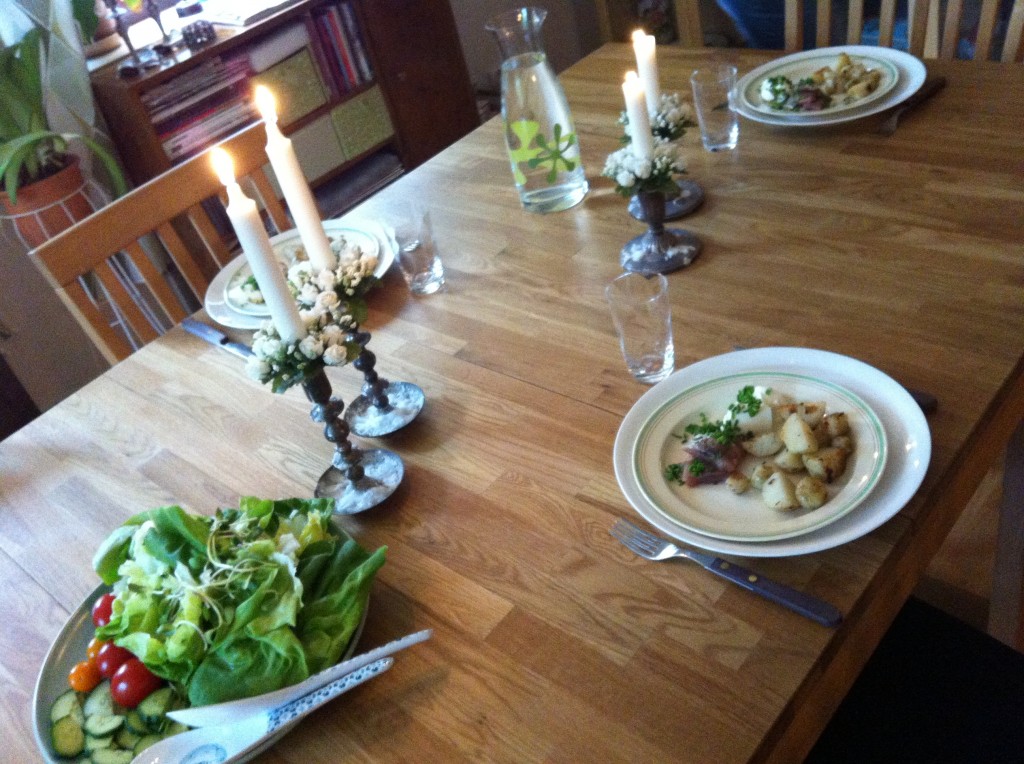
After a long day of paddle boarding, exploring the eco-city in the West Harbour and dinner, I sink into one of Mia’s butter yellow leather couches with a beer in my hand and feel my body unwind.
This … this is perfect.
A cold beer and beautiful balcony? Yes, please!
I know how lucky I am. And realize how amazing the opportunity Mia is providing me.
A Slice of Swedish Hospitality, started by Mia and her mother, Eva, promises to give guests just that — a true taste of what life as a local is like.
“This is about getting to know us Swedes, for real!” says Mia. “We believe the world can become a better place if we meet eye-to-eye and get a more humble feeling towards different cultures, social systems, political and religious views. New perspectives make me grow as a person and hopefully we can learn from each other.”
Having people over for supper is nothing new to this mother of two. In fact, as a child, living with her gardener parents, there were always people coming over for meals. Her mom always had an extra plate at the ready for guests stopping by.
Ready for dinner?
Before the Slice of Swedish Hospitality was started, Eva and her husband (Mia’s father, Anders) would rent their house for tourists, often times inviting those visitors over for meals or games.
Mia recalls it fondly. “We would have a lovely time discussing life in our countries and how we got the everyday life together. We still stay in contact. For these people, it was the best experience during their vacation.”
So, who is this experience good for? My answer: anyone who wants to get a better understanding of life as a Swede. For me, it gave me insight into great places to visit while in the country, as well as a beautiful look at the culture.
The program matches visitors with a network of the company’s hosts and allows them access to a family’s daily life in their own setting — a private home. Whether a family with children who wants to meet a local family with children, to young couples and beyond, there are matches to create that perfect Swedish evening.
“When do you ever get the chance to learn about Sweden if you don’t already have friends here?” Mia asks. “Here, you have conversations for real and get a chance to ask questions about Sweden, try the food we eat, have Swedish coffee …”
As for the future of the Malmo-based program — the sky is the limit.
“We would like an even wider range of ambassador families to open up their private homes, and to be able to do even better matching,” says Mia. “We have a range of hosts from 24-year-old girls who are single and study to families with young children and teenagers, to retired ambassadors, gay, single dads and more.”
Before I leave for the night, I empty my wallet of American money.
A little time later, I get a note from Mia: the boys, even now, still play with it. I like to think for as much of an impression the family left on me, there is a little of me left in Sweden, too.
Editor’s Note: My time in Sweden was courtesy of Visit Sweden, however all opinions are my own. If you have questions regarding this, please read my disclosure policy. Want more on Sweden? Follow along in Twitter and Instagram, #myswedentrip.
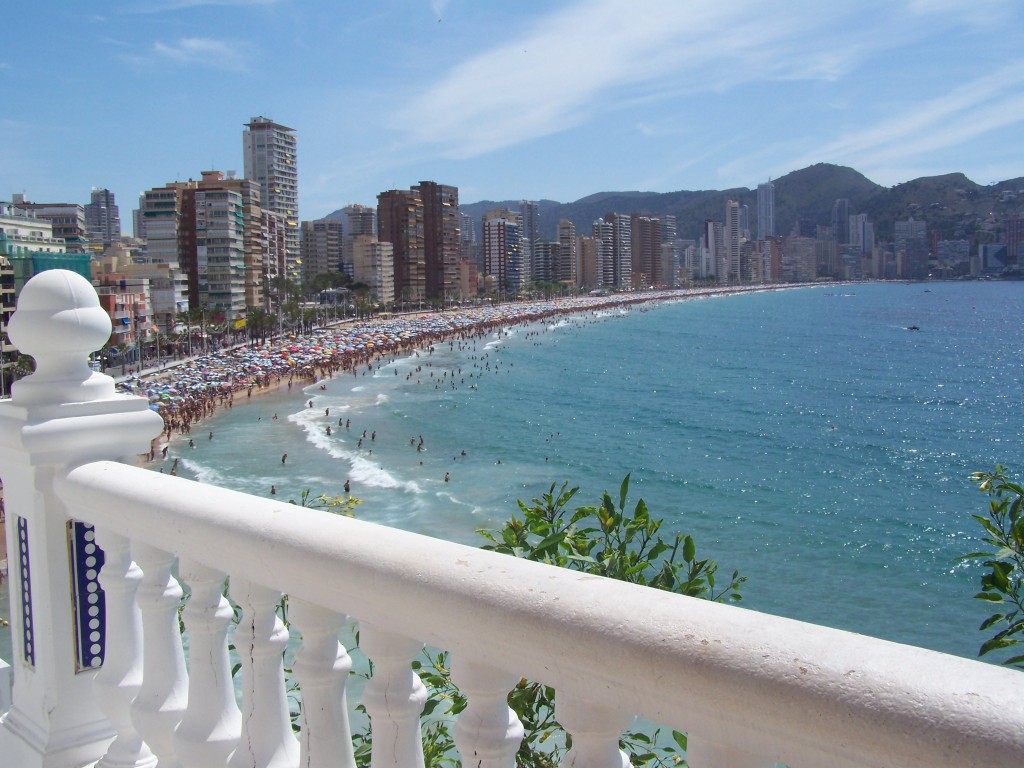
If you’ve ever visited Benidorm, Spain, you will notice it isn’t like other parts of the country. Sure, the beach is beautiful and packed with people, but a large part of the tourist crowd in this neck of the Land of Valencia are of the British variety.
Fish and chip shops mingle with tapas bars; skyscrapers cut into the horizon. But, even with a far more tourist vibe than other beaches, Benidorm still captivates.
My name is D and I used to be, as one friend put it, “a big, girlie prude.”
Never would I think of even taking off my shirt in a public, or semi-public place. In fact, when I first stopped at the baths in Budapest, it took everything I had to shimmy my swimsuit bottom off while strategically keep my towel from covering up the rest of me. I was not ready to take anything off. Getting naked in Sweden? Not. Even. A. Thought.
In Barcelona, I had to prep myself for going topless while on the beach.
In Morocco, I gathered a bit more courage and actually took off my top and walked around (gasp) topless while at the bath.
But, something happened to me between Morocco and Sweden: I got confident. The idea of stripping down to skin didn’t seem to bother me nearly as much. While my body had not changed, my opinion of myself had.
So, when it comes time for me to head to Kallbadhus Ribersborg, to take part in the traditional Swedish bathhouse experience, I don’t even blink. In fact, when Anna tells me she reserved a towel for me, I ask her for details about what I am going to do.
“Well, you take off your clothes … if you want … and then have a sauna and then go in the water,” she explains.
My mind skips back to the day before when I plunged into the Baltic Sea in a wet suit during my attempt at paddle boarding.
“What do the other people wear at the bath house?”
“Oh, most of them wear nothing,” she says.
Decided. Then I will wear nothing, too.
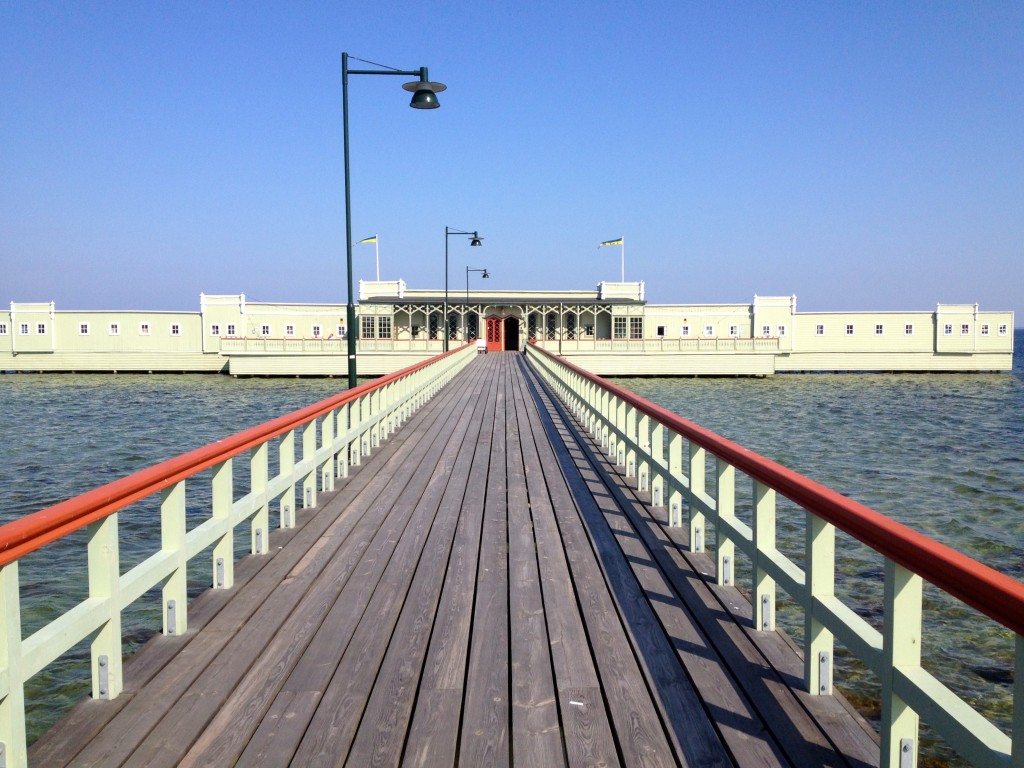
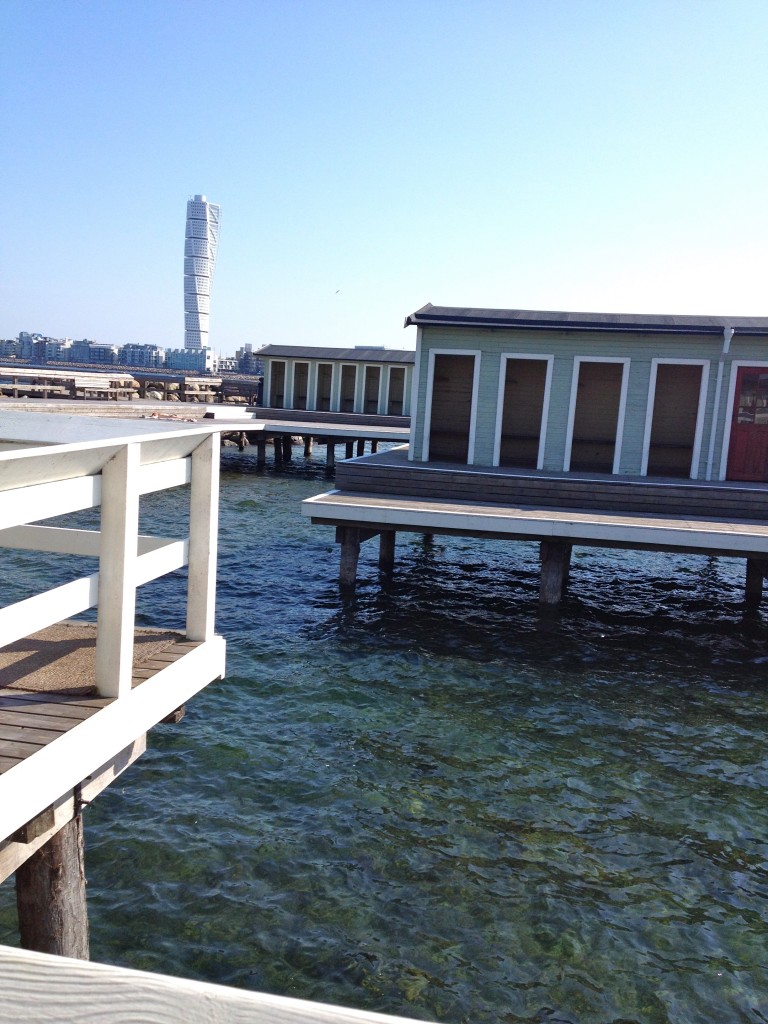
I don’t know how to explain it, but en route to the bath house via the long wooden walk over the soft thumping water of the sea, I am actually skipping and smiling at the idea of getting naked.
You’d have no clue just to the left of this photo that there are people naked in a bath house!
Like, I’m super stoked beyond belief. I blame it on the new, improved version of D after my shamanic session.
The point is, I am thrilled to put myself to this test, to prove to myself it is OK to shred the clothing and just hang out naked in the open.
See … don’t I just look like I want to take my clothes off?!?
I walk up to the counter of the creaky old (and still magnificent) Kallbadhus Ribersborg. The large dining room and reception area immediately conjures up images of grandeur when the bath house was first built. I can imagine groups of men and women flocking here on a warm summer afternoon to gossip and dip their toes into the fresh sea.
“I have a reservation,” I announce to the girl at the counter. She produces a scratchy and small white towel and directs me to the woman’s side of the bathhouse.
Little changing rooms open to the Baltic Sea at Kallbadhus Ribersborg.
I open the swing door and am greeted to wooden platforms a top the water. Lining one side of the boardwalk are little changing rooms — some with doors, some without.
I feel like I have stepped back in time.
Around me, there are a few women lounging naked, soaking up the morning sun.
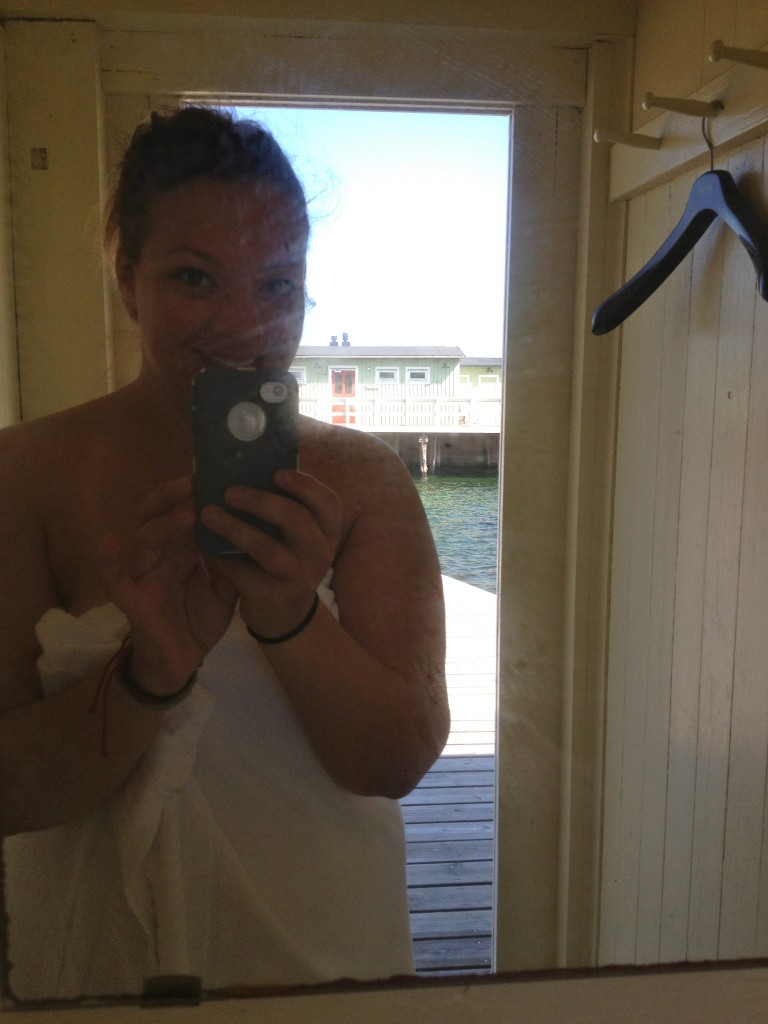
I walk quietly around them and pick a changing room without a door and stand in front of the mirror.
Here you go, D. Time to get naked.
This time, I don’t even hesitate. I pull my shirt off, my pants down and stand in my little room stark naked. I care so little about being in the nude that I actually take the time to fold up my clothing and place them in a neat little pile on the bench.
See? I am thrilled to be wrapped in a towel!
Then, with my towel wrapped around me, I head over to the sauna.
So, I’m not quite ready to strut around, but still.
As I walk by a bench filled with naked older women, I feel their eyes on me and remember a conversation I had the previous day with Anna: they may look at you strange if you don’t get naked.
I brush it off and sit in the baking warmth of the sauna for a few minutes, letting a few beads of sweat drip from my brow.
And now for the next part of the tradition — a dip into the sea.
I know it’s cold, but after letting myself bake in the heat of the sauna, I am ready for the cool water to jolt my body back to a more normal temperature.
I walk down the little boardwalk to a ladder, covered with seaweed because it likely has not been used since last summer. I tie my towel on the railing and dip my toes in.
Holyshititscoldwithoutawetsuit.
Shivers shoot through my body and it instantly becomes hard to breathe. But, I persist. I climb down another rung and let the water lap at my thighs.
Still absolutely freezing.
Then, I go for it, dunking my body into the salty water.
I last for about 15 seconds, but what matters to me is that I did it.
Huge smile on my face, I exit the water and pick a post on the wooden planks to lay for an hour. Naked.
At first, I feel weird. It’s just not the norm for an American to lay out without anything covering up anything.
But, as I see more and more people emerge from the changing rooms and splay themselves in the same fashion, I grow more and more comfortable.
I’m laying naked, tanning, in Sweden.
A smile lights up my face and in that moment, I could not be any cooler or happier.
For more information on Sweden, check out these books:
Editor’s Note: My time in Sweden was courtesy of Visit Sweden, however all opinions are my own. If you have questions regarding this, please read my disclosure policy. Want more on Sweden? Follow along in Twitter and Instagram, #myswedentrip.
There is no shortage of breathtaking vantage points in Sweden. On my last full day in the magnificent country, I headed back to the water on foot (as opposed to stand-up paddle boarding).
The crisp spring air, the cloudless sky and the Baltic Sea — which transformed from aquamarine to a deep royal blue — created the perfect moment of bliss on the coast of Malmo, Sweden.
Editor’s Note: My time in Sweden was courtesy of Visit Sweden, however all opinions are my own. If you have questions regarding this, please read my disclosure policy. Want more on Sweden? Follow along in Twitter and Instagram, #myswedentrip.
Apologies for the slacking of the “Daily Wanderlust” for a bit. I’ve been adjusting to life as an expat in Chiang Mai, so it’s been hard to keep these coming at the same rate I was.
To prepare you for what upcoming posts can include, wanted to go ahead and toss this little photo out.
It was taken at Elephant Nature Park the other day … while I was working. Yeah, my job pretty much rocks. This is a photo of two elephants, best friends, and one of their mahouts.
Michael, my stand-up paddle board instructor from Lomma Beach House, grips the front of my board, chest-deep in water.
“You’re going to stand again,” he promises. “Come on.”
I don’t want to do this.
“Really? I’m fine not …” I assure him.
“No. Stand up,” he suggests. “Put one leg underneath your body.”
I do so.
“Now, the other.”
Crouching on the board, I can already feel my thighs shiver.
“OK, good,” he says, squinting into the sun because I’ve taken his sunglasses. “Slowly, stand.”
A rare moment at Lomma Beach House where there are no lines for the little snack shop.
I’ve already tried this. Twenty minutes earlier. I was successful. For about 30 seconds. As soon as I gripped the paddle and attempted to actually do the task at hand — stand-up paddle boarding — I fell, face first into the oh-so fresh Baltic Sea.
I slowly rise, taking every ounce of strength in my legs to propel me up.
I’m doing it.
“OK, now, stay there, I have to go get my board,” he says, swishing through the sea behind me after his board, which has floated some distance away.
I’m doing it.
Then, my legs quiver more. The board dips to the left. Dips to the right. And, I plunge back into the water.
I brush off the water from my eyes and stand in the soft sand, water at my waist, smiling.
A far cry from the attitude I had earlier in the morning.
“I really, really don’t want to go paddle boarding,” I had confided in Anna, my guide for the last portion of my Sweden trip (through the Malmo region), when she picked me up from the train station.
In fact, when I had looked at the weather the other week from the safe confines of Las Vegas, I was delighted to see cool temperatures, rain and general gloom. Forgetting about the fact wet suits exist, I figured I wouldn’t even have to argue about the activity. It just wasn’t going to happen.
“It’s OK, you will like it,” she assured me as we drove past blooming fields of canola, glowing bright yellow on jade green stems.
I looked out the window, heart racing about the “light adventure” I was about to embark on.
I don’t do adventures. At all. I try. But every time I try to do something adventurous that involves my feet not being firmly planted on the ground, I end up in precarious situations (see Parafalling in Turkey for a prime example of what not to do when going paragliding).
When we parked at Lomma Beach House and walked up the sand to the wooden beach house, I saw two large paddle boards propped against the deck. My first instinct was to run back to the car and skip straight to our organic lunch. Immediately.
I have no desire in the world to do this. None at all. Nada.
“Come on,” she urged me.
Erik Bilder, the owner, and Michael, my instructor for the day, stood outside, waiting for us.
“I figured we would go out there and learn, then we will paddle board through the Lomma harbor, through what I like to call the bayou, and then over to the church,” Michael explained.
Ha. I can’t even imagine myself making it to an upright position on the board, let alone paddling around town.
Somehow, I managed to convince Anna and her friend to take the lesson with me (strength in numbers, right?), and the three of us headed into the changing room to put on wet suits.
“Is this like Spanx, where we have to struggle to put ourselves into the suit?” I asked to no one in particular.
Carefully, I put one leg and then the other into the suit, pulling it up, over my body and have Anna zip it up. When we walk out, it’s obvious we’ve done something wrong when Michael takes one look at us and stifles a laugh.
“You’ve put them on inside out,” he says.
You’ve got to be kidding.
“So we have to go back in and put them on again? We can’t just go like this?” I asked, dreading having to pull the suit off only to flip it right side and pull it back on my body … again.
“Sorry, yeah,” he says.
I hate this already.
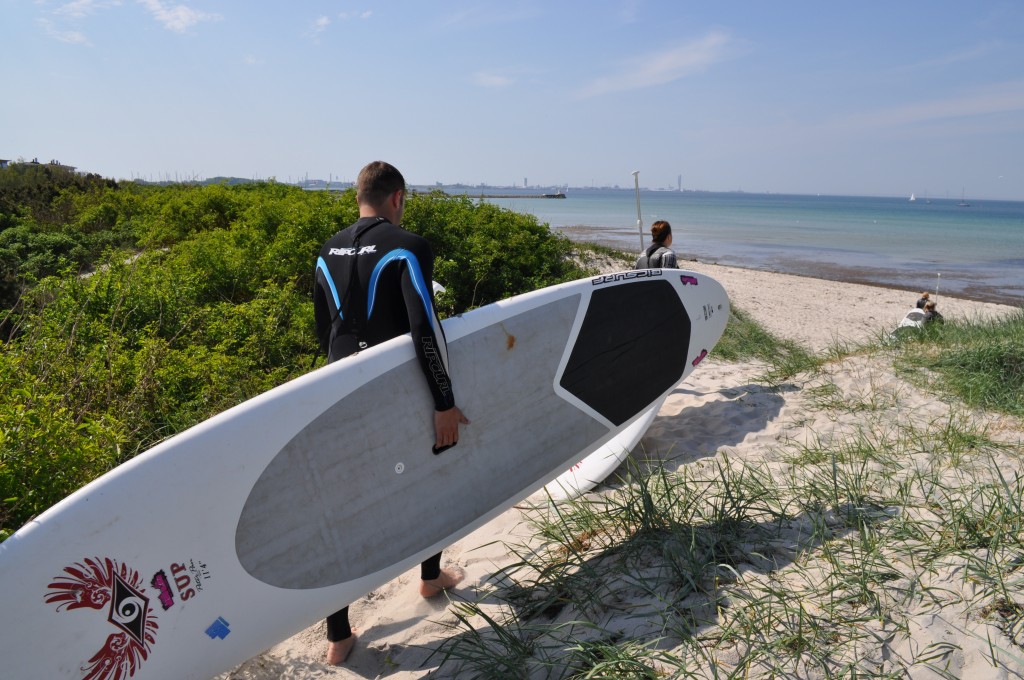
Finally, we emerged, suits on correctly, and head to the beach with our boards in tow.
Board in hand, ready to hit the chilly waters of the Baltic Sea.
“You will need to stretch first,” Michael instructed, beginning to do lunges. “Your legs are going to be shakey and tired if you don’t.”
The four of us, feet sinking into the sand, at the brim of the Baltic, attempt to loosen our legs.
Then, he begins to guide us through the basics of stand-up paddle boarding.
“You will start on your stomach,then, move one leg under your body and to the middle of the board, the sweet spot, and then the other. We’ll practice like this for a bit, then we will stand up.”
I won’t.
After showing us how to stand up, he goes through paddling. It’s an upper torso stroke, not an arm stroke.
“If your arms hurt, you’re doing it wrong,” he says, placing his opposite hand on top of the paddle and moving his upper body towards the oar. “This is the right way to paddle.”
I think back to the time I went kayaking in the Mediterranean. The circles I did in the water. Not being able to make it to the island without being towed.
He lifts his board and steps into the water, through feet of seaweed.
We follow suit, pulling the large boards behind us and stepping into the gooey mass of tangly weeds.
Immediately, the icy cold water sends shocks through my feet.
Thank goodness for wet suits.
We trudge through the seaweed and into the water.
Getting ready for the “light” adventure
“So, now we get on the boards,” he says, putting his upper body on the board and then pulling his legs on.
The other women I am with have no problem.
I try to do the same, flinging my body up. It’s not easy, but it isn’t as hard as I imagine either.
“Now, we need to get further out into the water,” he says, dipping his hands into the water and paddling with them, oar under his body.
I do the same, plunging my hands into the water. Like with my feet, the cold water sends shocks through me. But, after a few minutes, under the sun that finally decided to come out, it is refreshing.
Once we’ve gotten far enough out, it’s time to try to stand.
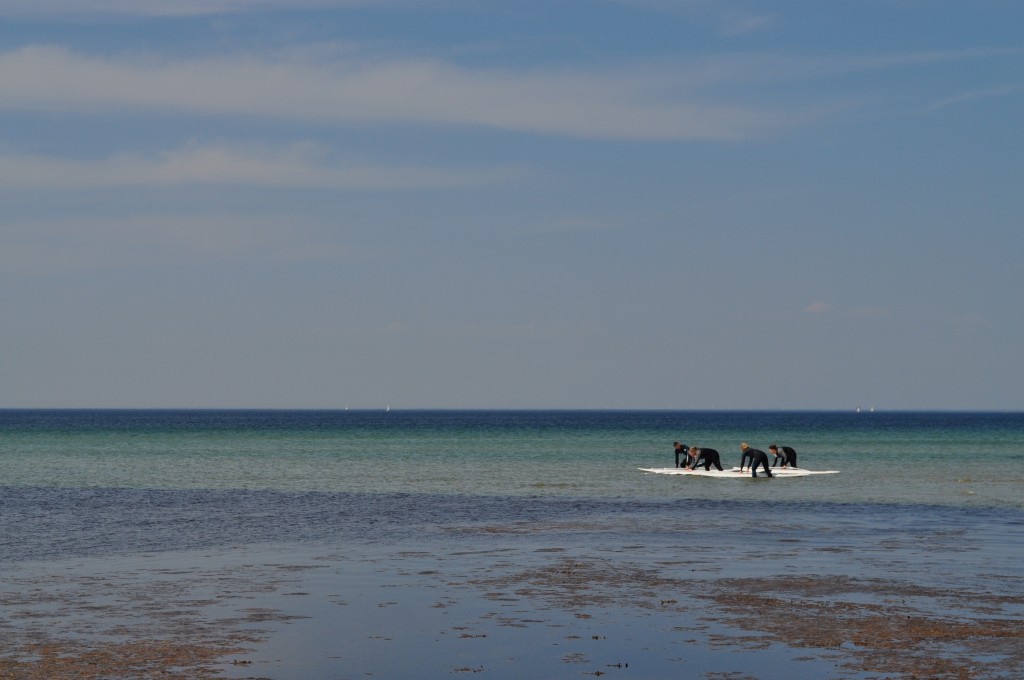
The beginnings of the stand-up portion.
Slowly, board dipping from side-to-side, I manage to pull myself onto my knees.
I’m kind of doing it.
I stay like this for awhile. Attempting to paddle, but the current and I aren’t friends. While the others stick together, I end up floating away from them.
Michael sees I’m straying and gets off his board and comes to get me.
“You’re pulling me in, eh?” I ask, being taken back to the kayak in Spain.
“You are just getting a little away from us,” he assures.
I prolong the stand-up part of the stand-up paddle boarding experience for a bit longer, trying to convince myself I can do it.
When the others stand and begin to paddle, I realize I have to do the same.
So, wobbly, and pulse thumping in my ears, I slowly try to stand.
“Put one leg under your body,” Michael instructs, keeping an eye on what I’m doing. “Now, move your other leg.”
I do so.
“Now, stand up,” he guides.
I stand.
Holy crap. I am standing. On a paddle board. In the sea.
“Now, paddle,” he says.
My thighs shake. I can’t move. Not yet.
I try to focus on a spot in the sea, like I do in yoga when trying to balance.
But, this is a moving sea. And the focus shifts. And I am distracted by the fear of falling.
I dip the paddle in the water. I feel the board dip to the left. To the right.
Don’t fall. Don’t fall.
I try again. This time, the board wobbles too much and I can’t keep my balance.
Then, I am face-first in the water. In the Baltic Sea.
Rather than being upset I’ve fallen, upset I couldn’t stay on the board, I am invigorated as the water hovers at my neck.
I’ve just fallen into the Baltic Sea. Fallen off of a paddle board I never imagined I’d ever be on. This rocks.
We continue in the water for another hour.
Well, Michael and I do. The others have gone in.
After my last attempt, which resulted in another plunge, I decide my “light” adventure is done for the day. I don’t want to admit it to Michael, so I at least keep the oar in my hands as I ply him with questions about his background. Turns out, like me, he is an avid traveler. He’s working the beach house this summer after a stint in Normandy working at a brewery.
The two of us straddle our boards, letting the water gently bob us and send us back to shore.
I liked sitting on the board more than standing!
When Eric comes to the beach and waves his arms at us, letting us know it’s time to come in, I actually don’t want to.
Maybe I will give it one more go before my time here ends …
He waves his arms some more.
Or maybe I won’t …
We head back to solid ground and I peel off my suit. It’s time to go to lunch, a quick bike ride away.
“I haven’t ridden a bike in more than a decade,” I tell Anna. “Maybe this is a bit too much adventure in a day for me?”
This time, she lets me off the hook as we head to Lomma’s new harbor.
“Light” adventure: accomplished. At least a little bit.
Editor’s Note: All photos are courtesy of Lomma Beach House. My time in Sweden is courtesy of Visit Sweden, however all opinions are my own. If you have questions regarding this, please read my disclosure policy. Want more on Sweden? Follow along in Twitter and Instagram, #myswedentrip.
Funny thing — nearly a year to the day I found myself once again at San Francisco’s airport. In July 2011, I was there because Abby and I were meeting Kristin and heading out for a girlie weekend in Napa; in July 2012, I was there because I was taking a flight across the Pacific and heading to my new home and life as an expat in Thailand.
It is wild to believe an entire year has passed since we were drinking wine and enjoying a girl’s-only weekend in California’s beautiful Napa Valley.
During our trip, we were fortunate enough to stay at my friend’s hotel, the charming Chardonnay Lodge.
This shot is from the garden in front of our hotel. The owner, Karin Patel, not only has gorgeous roses in bloom, but even a little vineyard with a table and chairs. So quaint and charming!
There are few companies I don’t like: United, PEPCO, Chik-Fil-A and T-Mobile.
Why?
United = horrid customer service and stupid fees that change
PEPCO = heads up their collective big-money arses
Chik-fil-A = narrow-minded PR nightmare
T-Mobile = crappy phones, crappy fees and the most epic of all fails ever — no service.
During my cross-country road trip, I had the privilege of learning first hand just how terrible T-Mobile is.
At first, when I had no service, I credited it to the fact that I was driving, oh, through the middle of nowhere Nebraska
En route from Nebraska to Illinois.
. Then, when I had no service in the cities, I started to get annoyed.
What’s worse? When I did have service, it wasn’t with T-Mobile so the data I was using was no longer unlimited. When I got a text message en route to Chicago that I had exceeded my data limit for the month, I nearly lost my marbles.
“You claim to have the largest 4G network in the world,” I said as calmly as I could to the customer service agent on the other end of the line. “How is it that throughout my entire road trip I have had little to no service and having to use another network’s internet? I’m driving across the country. What is the point of having a cell phone if you can’t use it?”
So, they did one thing right: they upped my data. Even the agent understood my need for being able to access the Web. “You can’t have no internet when you are driving across America.”
Right.
When we were out and about on our dive bar tour in NebraskaDriving home from our night out in Omaha. Awesome.Driving from Nebraska to Illinois … no service, no internet.Thank you, T-Mobile. How am I supposed to have a GPS if I don’t have my internet service I PAY FOR EVERY MONTH?Downtown Chicago and no phone service??Loading and loading and loading and then an internet connection error. In Maryland. Notice I was on AT&T.At a friend’s house in Maryland. And, once again, no service.No internet connection. Maryland. At least I have fleeting bars to make a call.And more. The one good thing? In Thailand, I have DTAC and have not had services issues once. Even in the jungle.
The icing on the cake??
Wonderful T-Mobile slaps me with a $200 cancellation fee when I tell them I am leaving the country for an extended period of time.
My advice? Opt for another carrier, another phone, another anything … or take the risk and see how it goes. I promise you this: if you live in Nebraska, Iowa, Indiana, Illinois, Kentucky, West Virginia or Maryland, you’re SOL for the most part.
Have you had similar issues with T-Mobile or another service?
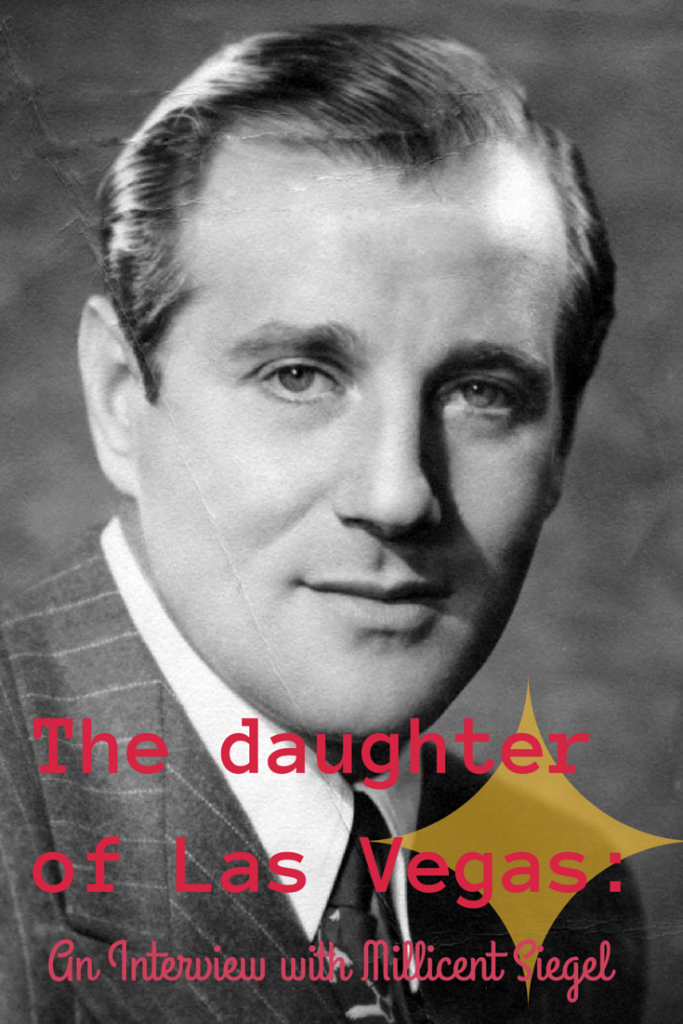
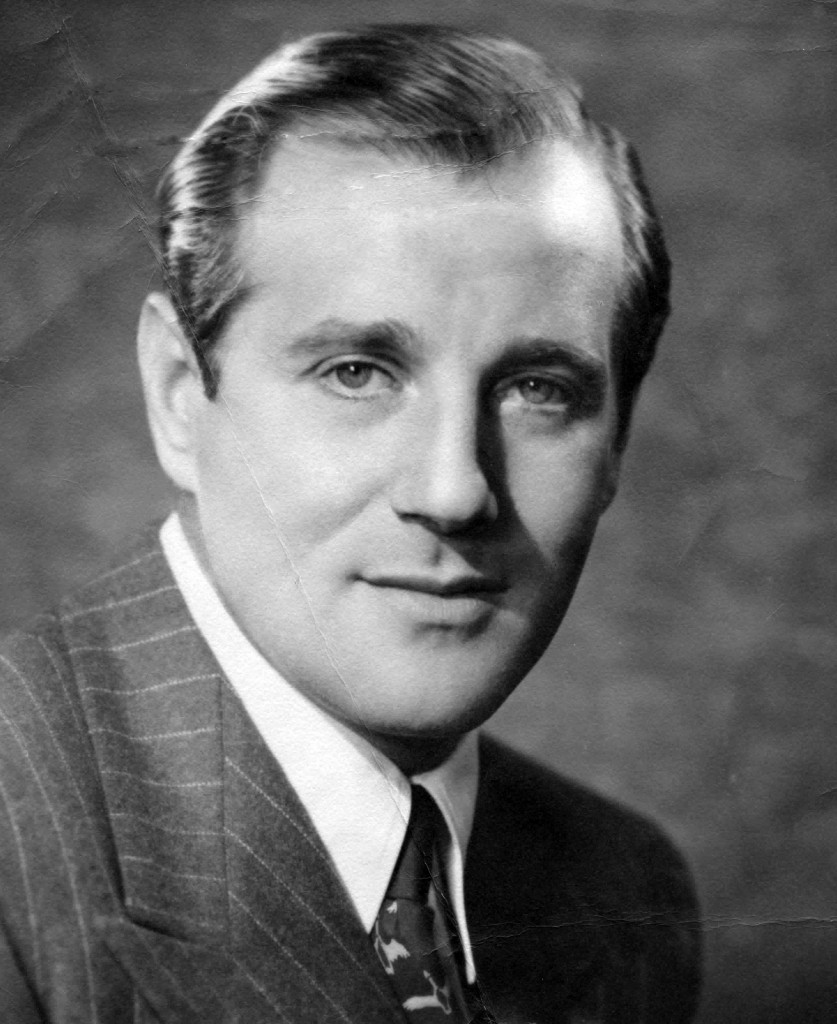
It was about 66 years ago when Millicent Siegel’s father, Ben “Bugsy” Siegel wrote a letter to his wife addressing his oldest daughter’s smoking habits.“I don’t like the idea of smoking at all, I would point out to her that it is not ladylike at all … Frankly, I hope she wouldn’t continue to smoke, as I dislike the habit in women and when I see her I will tell her just that.”
Decades later, I am sitting in Millicent’s Las Vegas condo as she pulls a drag from her cigarette, it’s neon orange tip glowing as she breathes in the smoke. Millicent, 81, hasn’t been weathered by the dry Las Vegas sun. Rather, she looks vibrant. Her shoulder-length blonde hair skims a peach and white striped shirt, which is paired today with white pants. Her light blue eyes sparkle when her pugs, Priscilla and Porsche, come to the table where we are sitting and chatting.
The letter, which was dated November 28, 1946, was written a mere seven months before her father was killed. Today, the letter can be found on display inside the Tropicana Las Vegas at the Mob Attraction, along with a bounty of other mob-related artifacts, including video footage (only in existence) of Bugsy Siegel the way she remembers him – as a father, not a mobster. And the father of Las Vegas.
Millicent Siegel poses with artifacts at The Mob Attraction
When Siegel first arrived to town in the 1940s, Las Vegas was nothing. But, Siegel saw something: opportunity.
“He envisioned Las Vegas to be a Palm Springs type in the desert,” says Millicent. “He wanted shops along [Las Vegas Blvd.]. He said there would be a sidewalk going all the way down into town.”
Thanks to his vision, within a few years, there was.
Growing up Hollywood
Before Siegel brought Palm Springs to Vegas, he and his family lived in Beverly Hills. Millicent’s childhood in the Hollywood town was nothing short of charmed. She was a brownie and took riding lessons with Elizabeth Taylor. Jean Harlow was her godmother.
As a young girl, Harlow would come to the house, put on an apron, and give her a bath. She even met her childhood crush, Cary Grant, face-to-face. At her house.
“When I came home from school, [Grant] was sitting in the room, waiting for my dad to get off the phone or something,” she recalls, smiling. “I thought I would die when I saw him sitting there.”
Then, came Las Vegas.
Ben Siegel’s Las Vegas
Las Vegas turned from what Millicent describes as a “hicktown” into something far more glamorous. Hotels lined the main Las Vegas drag, complete with swimming pools in the front, inviting people arriving by car to take a cool dip and break from the arid desert weather.
“There were no high rises,” says Millicent. “The hotels then were more personal, smaller, more comfortable. They didn’t have all of the pool parties … You’d go out for dinner at night and see a show. During the day, you’d spend time at the pool. Or, if you came when it was cool enough, you’d go riding or play golf.”
The vision Siegel had for Las Vegas, all those years ago, has morphed into a different beast entirely today. Now, mega resorts crowd The Strip. The historic properties are blown up to make way for the latest slick building, the hot restaurants, the trendy shops. The pools at the hotels now cater to the 20- something scantily clad partiers willing to throw down hundreds of dollars for the opportunity to sit in a cabana and sip on cocktails from bottles of liquor that have been marked up hundreds of percent.
“My dad would hate what Las Vegas it today,” she says. “What corporations did to Las Vegas was never his vision of this town.”
The town and times Millicent lived in Las Vegas were very different. And, unlike most other’s experiences even during the 40s. That’s what happens when your father owns the hottest hotel in Las Vegas, The Flamingo.
Siegel opened the hotel December 26, 1946 moving his family in during construction. As a teenager, living in a hotel was never dull.
Life at The Flamingo
“I was a spoiled brat,” says Millicent. “I mean, here is our hotel. We own a hotel.” Her life at The Flamingo was not without its own, special stories.
“One time, I decided to write post cards,” she begins. “All of the rooms were decorated with all sorts of personal things you would have in your house. On the desk was a crystal ink well. I took out to the pool and was writing these cards. My dad came out and saw me doing this and he had a fit.”
There was one night when Millicent was taken into the counting room of the casino with Chick, the brother of Virginia Hill (Siegel’s girlfriend). “I had a crush on him and I didn’t know what his job was at the hotel. He was in the accounting room at night, so I asked if he could take me in.”
Entering the counting room was like nothing she had ever seen before – stacks and stacks of money. Unlike stories which have been told which depict counters sorting money into piles, one for the hotel, one for them, she never witnessed anything like that. But, she did witness her father’s wrath.
“I stayed until they finished counting, until three or four in the morning,” she says. “Then, we went to breakfast and came back. That’s when my father walked in. He had a shit fit. I don’t think he was bothered that I was in the room, but he was bothered that someone took me in there. Who was I going to tell?”
Perhaps the best story from her time living at the hotel was when her father decided to put a moat in front of the property and import the hotel’s namesake – some flamingos. According to Millicent, there were between six and eight of these birds and, as the days went by, they were “dropping like fleas.”
Millicent recalls: “It was too hot for them. My dad stood out there and said ‘Those goddamn flamingos are dying on me.’ They never lasted very long. It was too hot for them. I think he replaced them once or twice and that was it.”
Today, the hotel which is now owned by Caesars Entertainment Corp., has flamingos on property. However, they are now inside in a climate-controlled garden.
Siegel, who treated the property as his home, could even be found walking through the halls, emptying ashtrays and tidying up.
As the founder of Las Vegas, Siegel took it upon himself to stay abreast of what was going on in town. He would donate money to organizations in need. “The town’s people liked him very much,” says Millicent. “He would go into Las Vegas and people would just come up and talk to him, have lunch with him.”
The creation of “Bugsy”
The famed mobster isn’t how Millicent sees Siegel. Despite Hollywood’s portrayal, his daughter remains steadfast in his role in the mob.
“A lot of stuff they say or still say about my dad wasn’t true or never happened,” she explains. The father Millicent remembers is nothing like Warren Beatty’s portrayal in the film “Bugsy.”
“He was very strict,” she says. “Most of what happened in the movie never happened. It was all a fabrication of what [the filmmakers] either read or surmised or just out and out faked.”
She quickly recounts two such instances in the film – the first depicting their move to LA, the second a birthday party she had. Neither of which were portrayed accurately.
“I would say 80 or 90 percent of the movie is inaccurate,” she says. “It portrayed [Siegel] as a nut.” Which is not even close to how Millicent remembers him.
“He was very strict,” she says. “We used to have to sit at the dinner table and he would ask us what was on the front page of the papers. He knew everything we were doing. He was very interested and on top of everything we did. He was also great fun to be around. He would joke a lot.”
Beatty declined Millicent’s offer to provide him with real-life accounts of her father while making the film.
The mobster, the father
Ask Milliecent about her father’s life in the mob, and she sits straight in her chair. After his death, stories began to surface about his life in the mob. “We knew him as a father. He worked some place. I was too young to question it,” she says.
Growing up in the shadow of gangsters didn’t phase Millicent. “We didn’t see these people as notorious, or different from anybody else. It was a whole new picture for me and I didn’t know how to put it. I never believed any of the things anyone has written about [Siegel]. They grew up in prohibition. They were no different than the Kennedys. They were selling the same stuff. They were doing the same thing. They were all extremely smart people.”
It was never easy for his daughter to hear the stories about life in the mob. Millicent has never gotten used to what people have said about her father, or his associates.
“It was hard to hear what people said about the man who would sit at the dinner table and make us tell him the news, or educate us on the way to cut our meat,” she says. “He wanted us to be princesses and the stories we heard didn’t jive with who we saw. I’ve always separated whatever anybody else might say from what I saw and what I felt. It hurt me. After he died, the whole thing just blew up in our faces.”
Even today, decades later, Millicent simply refuses to believe Siegel played any part in violent acts.
“I truly cannot believe my father would kill anyone. Beat them up, maybe. But, not kill,” she says. “I think it is a misconception.”
One of her last conversations with her father addressed his violent ties to the crime world. Millicent asked about his role in Murder Inc. with Meyer Lansky.
“He told me about not being able to make a living at 12 or 14, 15, 16 years old and not being able to make a living during prohibition,” she says. “I asked him about Murder Inc and he said, ‘You’ve met all of those people. Do they look like killers to you? Have they ever hurt you? Yes, I did [commit crimes], but now I am building a hotel and am 100 percent legitimate. They was my last in-depth conversation with my father.”
Millicent is quick to point out that Siegel, despite the stories of being a murderer, was never arrested for anything other than prohibition. To this day, she maintains he never killed a person.
On Siegel’s death
On June 20, 1947, Siegel was killed.
En route to Las Vegas via train to spend the summer with their father, Millicent and sister did not know what happened until they arrived to town. When the two arrived to town, their mother stood at the depot, waiting for them. The girls couldn’t understand why she was there. But, once they got to their uncle’s house, they were told of his death.
While no one knows the truth behind Siegel’s murder, Millicent has her own opinion.
“It wasn’t a random guy standing in a house, two houses down, that shot him. [Whoever killed him] was paid to do it. Who paid them? I don’t know. I’ve heard [his death] was all over money.”
Rumor has it that Meyer, another mobster and friend of Siegel’s, was the man behind his death. Millicent disagrees.
“If you have our father killed, would you be friendly and take care of his family?” She asks, recounting Meyer’s continued involvement with the bereaved. “Could you sit down to dinner next to me and know that you hired someone to kill my father?”
She isn’t sure exactly why Siegel was killed and questions the motives. “Was it somebody that wanted something in Vegas that he had? Did they want him not to be productive? Because, the hotel never closed. It wasn’t sold for years [after his death]. It’s hard to figure out, but I can’t lose sleep over it. I could never find the answers.”
In fact, no one has found the answers. In California, the case is still open.
Las Vegas, today
It takes nearly no time at all for Millicent to say how she feels about Las Vegas today. She hates it. When asked about what her father would think of it, she is quick in responding.
“He would be appalled,” she sighs, flicking out her cigarette.
Regardless of today’s Las Vegas, Millicent remains forever the doting daughter. “I am very proud of my father’s legacy,” she says. “He had the vision for the glamour … for bringing all of these people here.”
And now, even as the sun sets against the twinkling high-rises on the Las Vegas Strip, Siegel’s legacy can be seen as the throngs of visitors make their way, yard-stick drinks in their hands, en route to the casino in a town Siegel created.
It’s the perfect summer night to be lulled to sleep by nature.
Outside my window, I can hear light rain drops plunk gently off plump green leaves. Frogs whirring their mating calls.
Except, it’s not a perfect summer night.
It’s the worst night the DC Metro area has had in … as long as anyone can remember.
Mixed with that calm and peace of the summer orchestra is the ear-splitting buzz of a chainsaw, the hum of generators. The fresh smell of rain is replaced by gasoline that hangs thick in the humid June night.
Only a few hours earlier, my parents had warned me we were getting a major storm from Chicago. A derecho (basically a tidal wave of wind and storms that are rare).
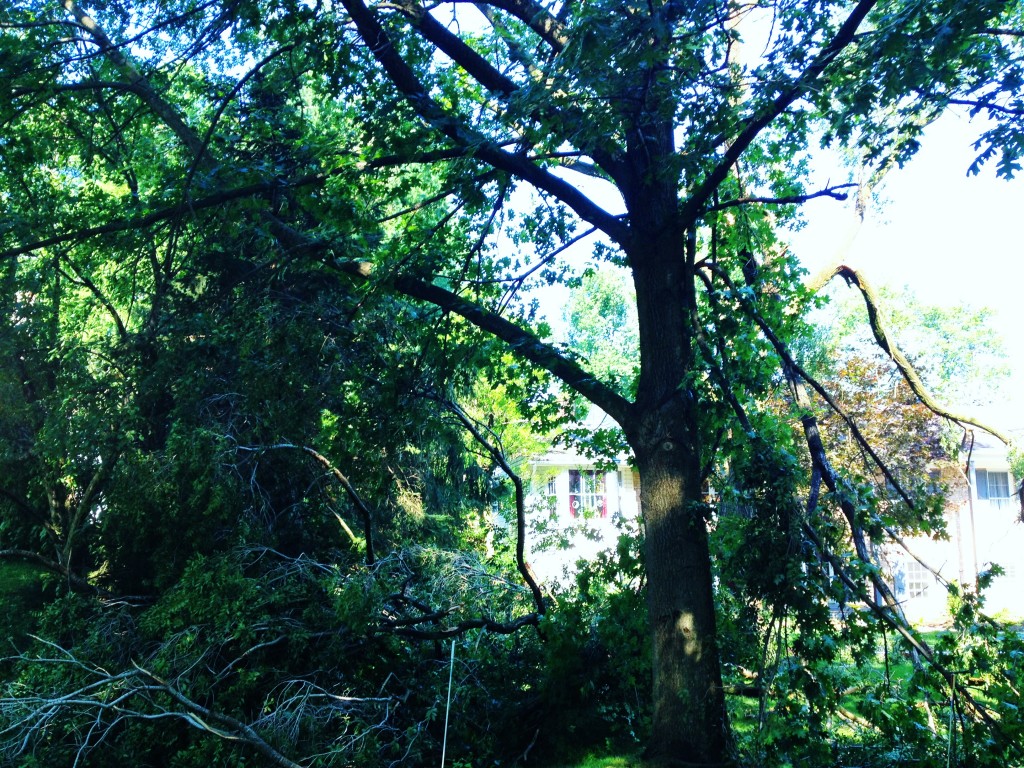
Then, as the sun set and the crickets took over, the wind picked up. Rushing across the landscape at 90 mph, the powerful wind carved a path of destruction. Transformers blew. Thick, old trees were uprooted. Trampolines (yes, trampolines) were tossed into the middle of the street. Like a tornado, but without the quickness.
And, the night sky glowed almost a continuous pale blue from electricity cutting into it.
I was inside for most of it, looking out the window as the lightning splashed across the sky. From my safe confines, I didn’t hear the wind whip outside. I didn’t hear the cracking of branches and the bangs when they hit the ground.
As I drove home after the storm, a graveyard of trees littered the streets. Barely noticeable until on them, oncoming cars would flash their lights in warning.
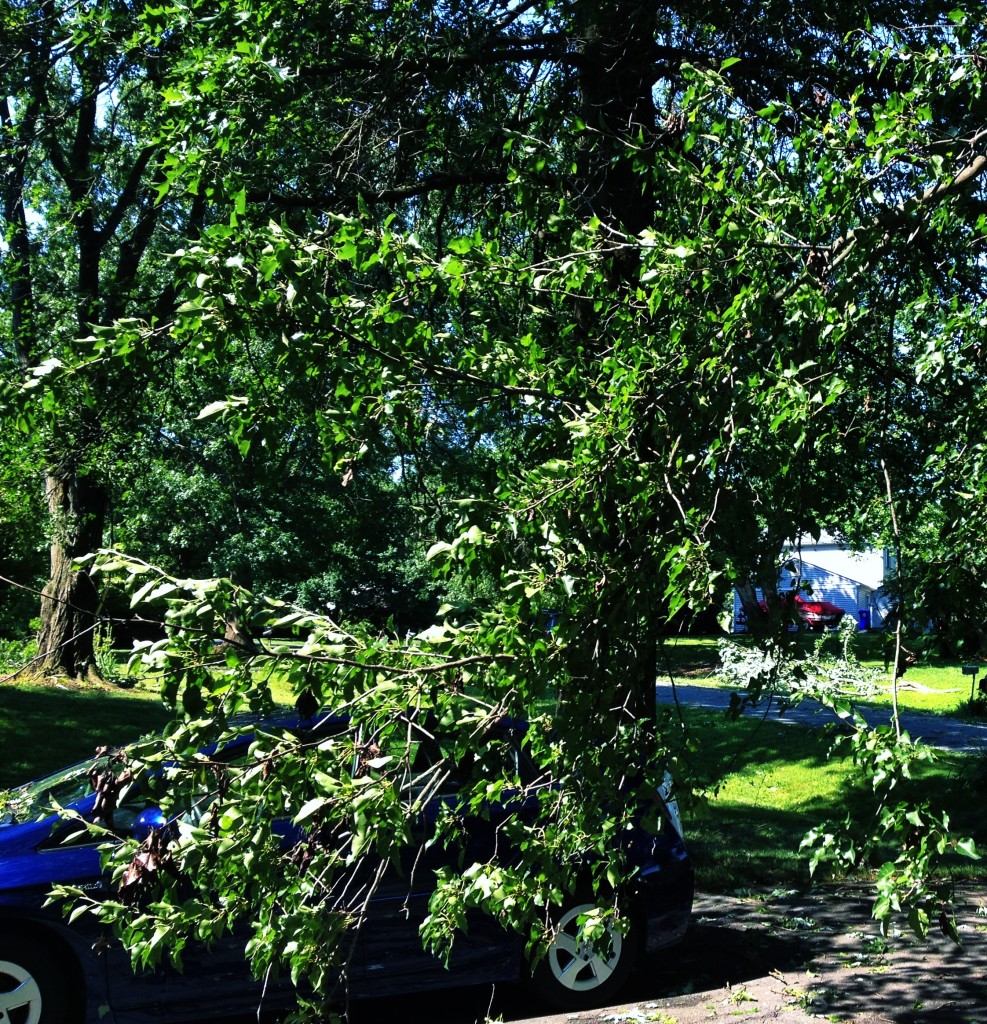
When I pulled into my neighborhood, I couldn’t even get to my house because a huge portion of tree was splayed across the road.
This storm … it’s serious.
The spot my car would have been parked …An old tree, that was one full and towering, is splintered from the extreme wind gusts.Nearly an entire tree rests on the ground after the storm.
PEPCO, our power supplier, only manages to supply power back to half of our neighborhood. Within 48 hours after the storm. Us? We aren’t nearly as lucky.
For six days, there is no power. My parents suffer more than I do. I hightail it to friends houses to stay cool and panic about the projects I have to do and the lack of power. There’s little cell service. Internet is down. Cable is down. It’s hot. It’s humid. People are cranky and mean.
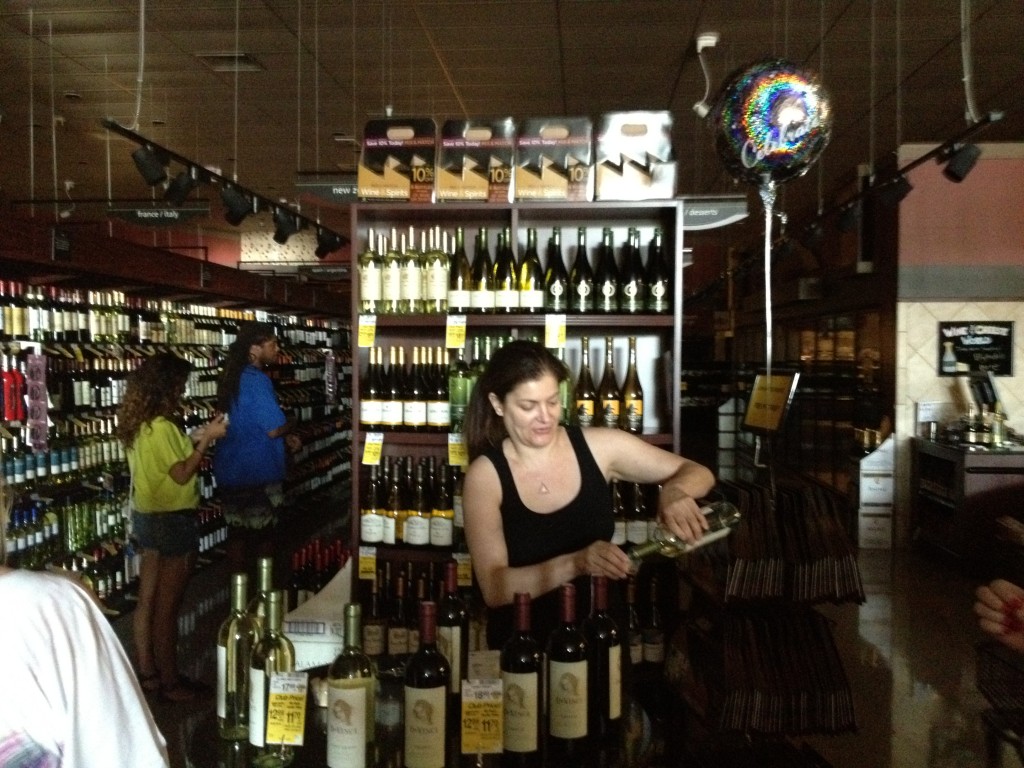
The only place open for food in a 10-mile radius? McDonald’s. This line took about 45 minutes.A day after the storm, powered by backup generators, Safeway taps into our boredom and a distributor comes in to do a wine sampling.
My neighborhood is one of the last to have power restored.
When it comes on, I feel relieved. Stressed at the amount of work I have to do before I leave America … in five days. But happy to have my house back and time with my family. Home.

























 D Travels 'Round